With the current rise in energy prices and increasingly strict environmental regulations, consumers are actively seeking more efficient, safer, and environmentally responsible water heater solutions. Among various modern heating technologies, induction water heaters are becoming one of the most advanced and promising choices.
But the question many buyers ask is simple:
Is an induction water heater really worth choosing?
The answer, for both residential and industrial users, is yes—and the reasons go far beyond simple energy savings. This article will explore in detail why induction water heaters represent the future of water heating and why making the switch is a smart long-term investment.
1. What is an induction water heater?
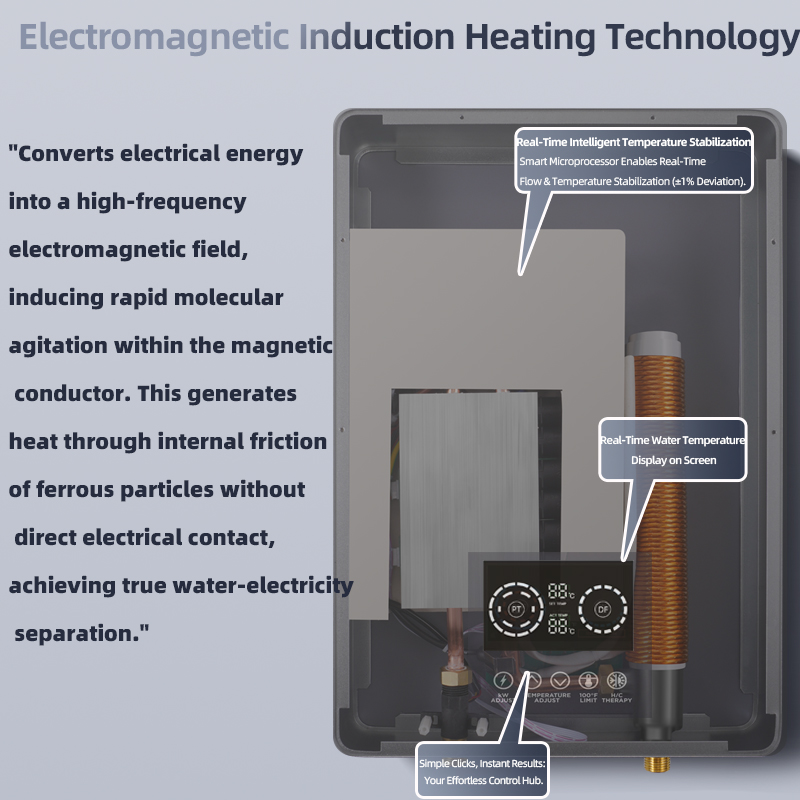
Induction water heater uses the principle of induction to directly generate heat in a metal heating element or pipeline,
and then transfers the heat to water. Finally, get a hot shower. It works differently from traditional electric heaters
or gas heating that burns fossil fuels. The biggest advantage of induction heating is that it generates heat when
there is no contact between the heating load and water, making it very safe.
In an induction system:
Alternating current creates a high-frequency magnetic field;
The magnetic field induces eddy currents inside the metal heating core;
The metal core heats up rapidly and evenly;
Heat transfers efficiently to the water.
This advanced process leads to extremely high energy efficiency and exceptional reliability.
2. Excellent energy efficiency
One of the biggest reasons for choosing induction water heating is its excellent energy efficiency.
2.1 Ultra high thermal efficiency
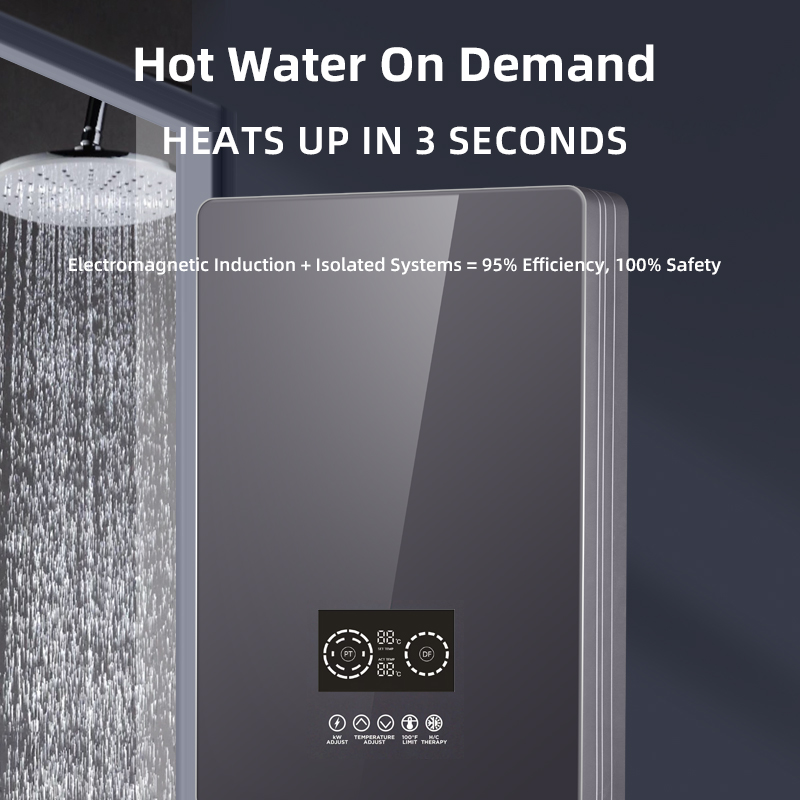
The thermal efficiency of induction water heaters reaches 95% -98%, far exceeding traditional systems:

This means nearly all consumed electricity is converted directly into useful heat, with minimal losses.
2.2 Lower Operating Costs
Because of the high efficiency, induction systems require less energy to produce the same amount of hot water. Over time, this results in substantial cost savings on electricity or fuel bills—especially in high-usage applications such as:
Hotels
Hospitals
Factories
Commercial kitchens
Residential heating systems
3. Maximum Safety: Water and Electricity Fully Isolated
Safety is another major advantage of induction technology.
3.1 Water-Electricity Separation
Traditional electric water heaters place heating elements in direct contact with water. Over time, scale buildup, corrosion, and insulation failure can create serious electrical hazards.
Induction water heaters eliminate this risk entirely:
No heating element touches the water
Heat is transferred through a sealed metal wall
The water system and electrical system are physically isolated
This design virtually eliminates risks of:
Electric leakage
Short circuits
Electric shock
Explosion due to dry burning
3.2 Intelligent Protection Systems
Modern induction water heaters include multiple layers of protection:
Over-temperature protection
Over-current protection
Dry-burn prevention
Leakage detection
Automatic shutdown during abnormal operation
This makes induction systems among the safest heating solutions available today.
4. Exceptional Durability and Low Maintenance
4.1 No Heating Element Burnout
Traditional electric heaters rely on resistance elements that degrade, scale up, and eventually burn out. Induction systems have no consumable heating element, drastically extending service life.
4.2 Reduced Scaling and Corrosion
Because there is no direct contact between heating elements and water, mineral scaling is greatly reduced. This leads to:
Stable long-term performance
Minimal efficiency degradation
Fewer maintenance interventions
Lower lifetime operating costs
In many cases, induction water heaters can operate reliably for 15–20 years with minimal servicing.
5. Environmental protection and carbon neutrality
5.1 Zero emissions on site
Induction water heaters do not produce combustion gases, smoke, or on-site emissions of carbon monoxide.
This makes them very suitable for:
green building
urban environment
Indoor installation
Enterprises with strict emission regulations
5.2 Compatibility with renewable energy sources
Due to the fact that induction systems rely on electricity for operation, they can be directly powered by renewable energy sources, such as:
Solar panels
wind energy
hydropower
Energy Storage System
This positions induction heating as a key technology for achieving long-term carbon neutrality goals.
6. Fast Heating and Precise Temperature Control
Induction water heaters deliver rapid and precise heating performance:
Instant heat generation
High heating power density
Extremely fast response time
Stable temperature output
Advanced digital controllers allow precise temperature management within ±1°C, ensuring consistent comfort and reliable process control for industrial applications.
Conclusion: Is an induction water heater worth choosing?
Of course.
Induction water heaters are not only a substitute for traditional heating,
but also a technological upgrade. It has excellent performance in terms
of efficiency, safety, durability, environmental friendliness, and total operating costs.
For homeowners seeking comfort and safety, as well as businesses pursuing sustainable growth and excellent operations,
induction hot water is not only worth choosing, but also the wisest choice for the future.