Single - and multi-turn induction heating coils
Induction Heating coils are one of the most important and easily overlooked components in an Induction Heating system.
When selecting models, many customers often focus more on the power and power brands and overlook important issues.
Which coil should I choose, single-turn or multi-turn?
In fact, differences in coil structure directly affect heating efficiency, temperature rise rate, temperature uniformity and system stability. The following explains the difference between the two in a simple way. 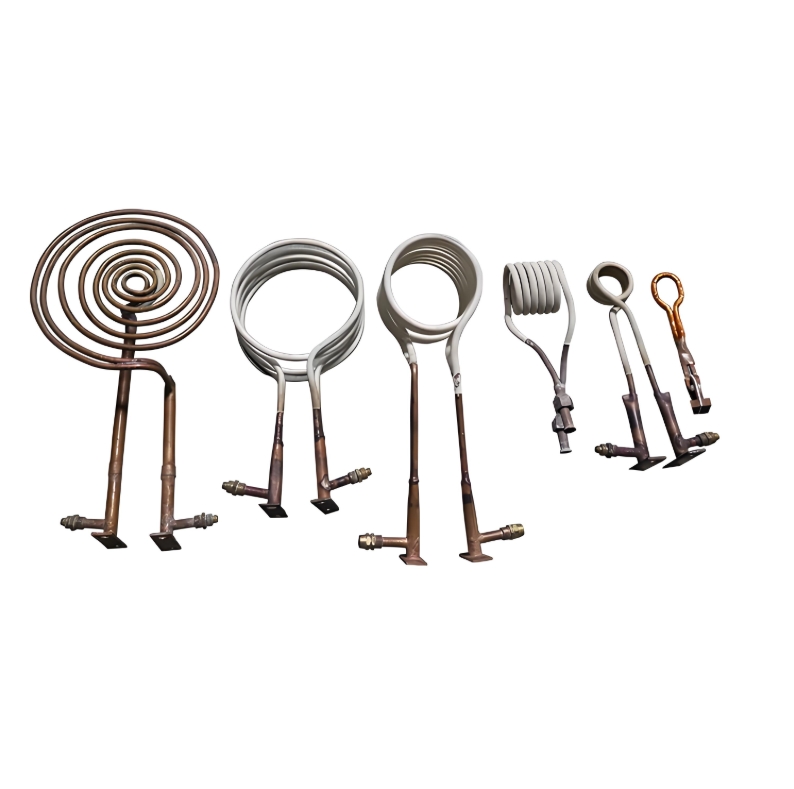
1, Single - Turn Induction what is a Heating Coil?
A single turn coil is literally an induction coil consisting of a single turn copper tube or copper bar.
Main features
Simple structure, one-turn conductor
The coil resistance is low, the current is high
The magnetic field intensity is concentrated, the range of action is small
Suitable application scenes
A process that requires rapid heating
Work with short and concentrated heating areas
High power, short heating needs
Example: local heat treatment, edge heating, rapid welding
Summary of advantages
The temperature rise is fast
It has a strong magnetic field
Simple structure, quick response.
Points to note
Relatively concentrated temperature distribution
Not suitable for uniform heating of long workpieces or large areas
Power supply and cooling system
2. What is a Multi - Turn Induction Heating Coil?
A multi-turn coil consists of a copper tube or copper bar of multiple turns wound at regular intervals, and is generally three turns, five turns, and even more.
Main features
More coil turns, more uniform magnetic field distribution
The current is relatively small, but the range is wide.
The heating process is more stable and controllable
Suitable application scenes
Processes that require uniform heating
Work with long heating length or large area
A set of continuous production lines and industrial furnaces
Examples: pipe heating, rotary kiln, drying, annealing process
Summary of advantages
Uniform temperature distribution
The heating process is stable.
Suitable for continuous operation and long use
Points to note
The heating rate is a little slower than a single turn.
The structure is more complex, the design requirements are higher
The matching of coil spacing and frequency is very demanding
3. Comparison of the core differences between single-turn and multi-turn
Comparison dimensions single turn coil multiple turn coil
The heating rate is very fast.
Temperature homogeneity, usually very good.
The heating range, the concentrated region, the wide, continuous range
Structural complexity, simplicity, relative complexity.
Application process rapid, short time heating stable, uniform heating
System stability, moderate.
How should I choose? These four questions are the key.
In real projects, it's not always "which is good" but "which is better". You can judge from the following problems:
1.How long is the heating length?
It's short and concentrated.
Long continuous = > multiple turns
2.Which is more important, speed or uniformity?
The pursuit of speed
Seeking uniformity = > multiple turns
3.Is continuous operation necessary for a long time?
Short time, intermittent operation = > single turn
Stable operation for a long time = > multiple turns
4. Is the process demanding on temperature control?
General requirements - single turn is enough
Precise control is more suitable for multiple turns
The design of the coil is more important than the number of turns itself.
I want to emphasize in particular
A single turn or multiple turn is just a form, and it is the overall design that determines the actual effect.
This includes the following.
The diameter of the coil matches the workpiece
Whether the distance between turns is reasonable
Matching with power supply frequency
Whether they have enough cooling systems
Reasonably designed multi-turn coils are often more efficient and longer in life than "randomly made" single-turn coils.
Sixth, conclusion: choosing the right coil directly improves the efficiency of the system
Single-turn: faster, more powerful, shorter time, suitable for high intensity heating
Multi-turn: more stable, more uniform, suitable for industrialization and continuous production
In induction heating systems, the coil is the core, not an accessory.
By choosing the right coil structure, you can achieve faster heating, lower energy consumption and more stable operating effects without increasing power.
If you are working on a specific project, we recommend that you consider the actual process parameters and have a specialist coil design team. Rather than simply applying the standard scheme.